>> P.137
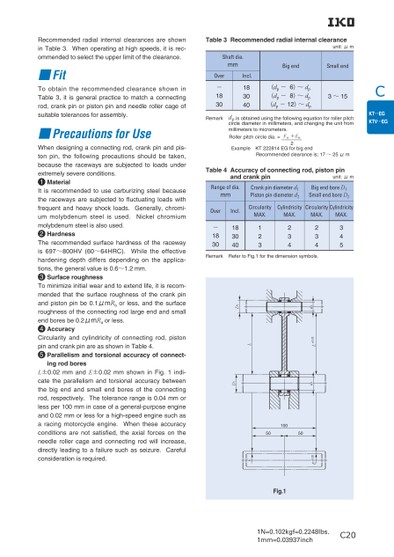
C1N=0.102kgf=0.2248lbs.1mm=0.03937inchunit: μmBig endSmall end(dp- 6) 〜 dp(dp- 8) 〜 dp(dp-12) 〜 dp3〜15Shaft dia.mmOver Incl.1830408-130Remark p is obtained using the following equation for roller pitch circle diameter in millimeters, and changing the unit from millimeters to micrometers. Roller pitch circle dia. = Fw +Ew2 ExampleKT 222814 EG for big end Recommended clearance is; 17〜25μmTable 4 ccuracy of connecting rod, piston pin and crank pinunit: μmRange of dia. mmCrank pin diameter d1Piston pin diameter d2Big end bore D1Small end bore D2OverIncl.Circularity Cylindricity Circularity Cylindricity MAX.MAX.MAX.MAX.3452342341231830408-130Remark efer to Fig.1 for the dimension symbols. C202dL±0.021dE±0.021005050Fig.1LED2D1in Table 3. When operating at high speeds, it is rec-ommended to select the upper limit of the clearance.■FitTo obtain the recommended clearance shown in Table 3, it is general practice to match a connecting rod, crank pin or piston pin and needle roller cage of suitable tolerances for assembly.■Precautions for UseWhen designing a connecting rod, crank pin and pis-ton pin, the following precautions should be taken, because the raceways are subjected to loads under extremely severe conditions.1 MaterialIt is recommended to use carburizing steel because the raceways are subjected to uctuating loads with frequent and heavy shock loads. Generally, chromi-um molybdenum steel is used. Nickel chromium molybdenum steel is also used.2 HardnessThe recommended surface hardness of the raceway is 697〜800HV (60〜64HRC). While the effective hardening depth differs depending on the applica-tions, the general value is 0.6〜1.2 mm.3 Surface roughnessTo minimize initial wear and to extend life, it is recom-that mended the surface roughness of the crank pin and piston pin be 0.1μmRa or less, and the surface roughness of the connecting rod large end and small end bores be 0.2μmRa or less.4 AccuracyCircularity and cylindricity of connecting rod, piston pin and crank pin are as shown in Table 4. 5 arallelism and torsional accuracy of connect-ing rod boresL±0.02 mm and E±0.02 mm shown cate the parallelism and torsional accuracy between in Fig. 1 indi-the big end and small end bores of the connecting rod, respectively. The tolerance range is 0.04 mm or less per 100 mm in case of a general-purpose engine and 0.02 mm or less for a high-speed engine such as a racing motorcycle engine. When these accuracy conditions are not satised, the axial forces on the needle roller cage and connecting rod will increase, directly leading to a failure such as seizure. Careful consideration is required.Recommended radial internal clearances are shown Table 3 Recommended radial internal clearance
 | <
| <  |
|  > |
> |  >>
>>