>> P.62
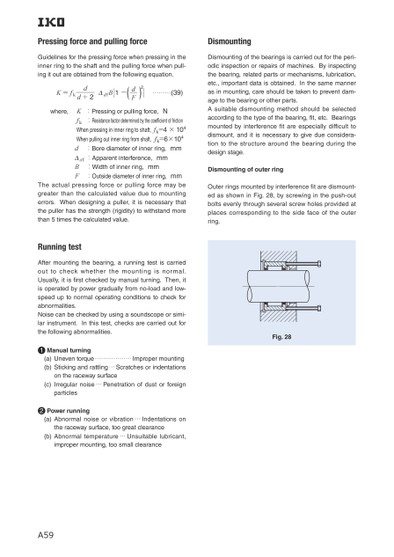
Pressing force and pulling forceDismountingGuidelines for the pressing force when pressing in the Dismounting of the bearings is carried out for the peri-inner ring to the shaft and the pulling force when pull-odic inspection or repairs of machines. By inspecting ing it out are obtained from the following equation.the bearing, related parts or mechanisms, lubrication, etc., important data is obtained. In the same manner as in mounting, care should be taken to prevent dam-age to the bearing or other parts.A suitable dismounting method should be selected according to the type of the bearing, t, etc. Bearings mounted by interference fit are especially difficult to dismount, and it is necessary to give due considera-tion to the structure around the bearing during the design stage.Dismounting of outer ringOuter rings mounted by interference t are dismount-ed as shown in Fig. 28, by screwing in the push-out bolts evenly through several screw holes provided at places corresponding to the side face of the outer ring.Fig. 28}2( )dF{dd+2K=fk ∆dfB 1- ………(39):Pressing or pulling force, Nwhere, K fk :Resistance factor determined by the coefficient of friction When pressing in inner ring to shaft, fk=4×10⁴ When pulling out inner ring from shaft, fk=6×10⁴d:Bore diameter of inner ring, mm∆df:Apparent interference, mmB:Width of inner ring, mmF:Outside diameter of inner ring, mmThe actual pressing force or pulling force may be greater than the calculated value due to mounting errors. When designing a puller, it is necessary that the puller has the strength (rigidity) to withstand more than 5 times the calculated value.Running testAfter mounting the bearing, a running test is carried out to check whether the mounting is normal. Usually, it is rst checked by manual turning. Then, it is operated by power gradually from no-load and low-speed up to normal operating conditions to check for abnormalities.Noise can be checked by using a soundscope or simi-lar instrument. In this test, checks are carried out for the following abnormalities.1 Manual turning(a) Uneven torque ……………… Improper mounting(b) Sticking and rattling … Scratches or indentations on the raceway surface(c) Irregular noise … Penetration of dust or foreign particles2 Power running(a) Abnormal noise or vibration … Indentations on the raceway surface, too great clearance(b) Abnormal temperature … Unsuitable lubricant, improper mounting, too small clearanceA59
 | <
| <  |
|  > |
> |  >>
>>