>> P.56
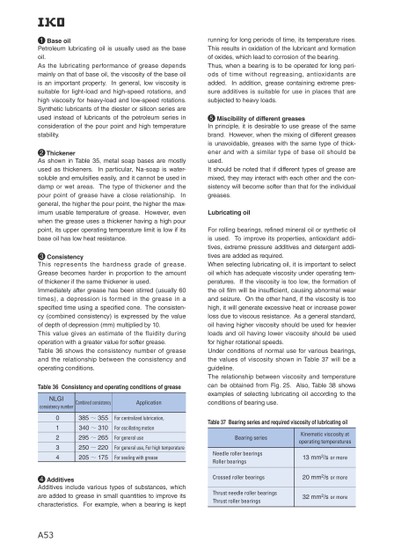
1 Base oilPetroleum lubricating oil oil.is usually used as the base This results in oxidation of the lubricant and formation running for long periods of time, its temperature rises. of oxides, which lead to corrosion of the bearing.As the lubricating performance of grease depends Thus, when a bearing is to be operated for long peri-mainly on that of base oil, the viscosity of the base oil ods of time without regreasing, antioxidants are is an important property. In general, low viscosity is added. In addition, grease containing extreme pres-suitable for light-load and high-speed rotations, and sure additives is suitable for use in places that are high viscosity for heavy-load and low-speed rotations. subjected to heavy loads.Synthetic lubricants of the diester or silicon series are used instead of lubricants of the petroleum series in consideration of the pour point and high temperature 5 Miscibility of different greasesIn principle, it is desirable to use grease of the same stability.2 ThickenerAs shown in Table 35, metal soap bases are mostly brand. However, when the mixing of different greases is unavoidable, greases with the same type of thick-ener and with a similar type of base oil should be used.used as thickeners. In particular, Na-soap is water-It should be noted that if different types of grease are soluble and emulsies easily, and it cannot be used in mixed, they may interact with each other and the con-damp or wet areas. The type of thickener and the sistency will become softer than that for the individual pour point of grease have a close relationship. In greases.general, the higher the pour point, the higher the max-imum usable temperature of grease. However, even Lubricating oilwhen the grease uses a thickener having a high pour point, its upper operating temperature limit is low if its For rolling bearings, rened mineral oil or synthetic oil base oil has low heat resistance.3 ConsistencyThis represents is used. To improve its properties, antioxidant addi-tives, extreme pressure additives and detergent addi-tives are added as required.the hardness grade of grease. When selecting lubricating oil, it is important to select Grease becomes harder in proportion to the amount oil which has adequate viscosity under operating tem-of thickener if the same thickener is used.peratures. If the viscosity is too low, the formation of Immediately after grease has been stirred (usually 60 the oil lm will be insufficient, causing abnormal wear times), a depression is formed in the grease in a and seizure. On the other hand, if the viscosity is too specied time using a specied cone. The consisten-high, it will generate excessive heat or increase power cy (combined consistency) is expressed by the value loss due to viscous resistance. As a general standard, of depth of depression (mm) multiplied by 10.oil having higher viscosity should be used for heavier This value gives an estimate of the fluidity during loads and oil having lower viscosity should be used operation with a greater value for softer grease.for higher rotational speeds.Table 36 shows the consistency number of grease Under conditions of normal use for various bearings, and the relationship between the consistency and the values of viscosity shown in Table 37 will be a operating conditions.guideline.Table 36 Consistency and operating conditions of greaseNLGIconsistency numberCombined consistencyApplicationconditions of bearing use.The relationship between viscosity and temperature can be obtained from Fig. 25. Also, Table 38 shows examples of selecting lubricating oil according to the 01234385 〜 355For centralized lubrication, 340 〜 310For oscillating motion295 〜 265For general use250 〜 220For general use, For high temperature205 〜 175For sealing with grease4 AdditivesAdditives include various types of substances, which are added to grease in small quantities to improve its characteristics. For example, when a bearing is kept Table 37 Bearing series and required viscosity of lubricating oilBearing seriesNeedle roller bearings Roller bearingsKinematic viscosity at operating temperatures13 mm2/s or moreCrossed roller bearings20 mm2/s or moreThrust needle roller bearingsThrust roller bearings32 mm2/s or moreA53
 | <
| <  |
|  > |
> |  >>
>>