>> P.51
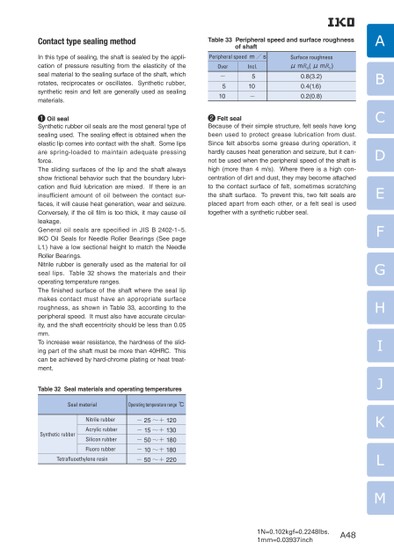
1N=0.102kgf=0.2248lbs.1mm=0.03937inchContact type sealing methodTable 33 Peripheral speed and surface roughness of shaftIn this type of sealing, the shaft is sealed by the appli-Peripheral speed m/scation of pressure resulting from the elasticity of the seal material to the sealing surface of the shaft, which rotates, reciprocates or oscillates. Synthetic rubber, synthetic resin and felt are generally used as sealing materials.Over- 510Incl. 510-Surface roughnessμmRa(μmRy)0.8(3.2)0.4(1.6)0.2(0.8)1 Oil sealSynthetic rubber oil seals are the most general type of 2 Felt sealBecause of their simple structure, felt seals have long sealing used. The sealing effect is obtained when the been used to protect grease lubrication from dust. elastic lip comes into contact with the shaft. Some lips Since felt absorbs some grease during operation, it are spring-loaded to maintain adequate pressing hardly causes heat generation and seizure, but it can-force.not be used when the peripheral speed of the shaft is The sliding surfaces of the lip and the shaft always high (more than 4 m/s). Where there is a high con-show frictional behavior such that the boundary lubri-centration of dirt and dust, they may become attached cation and uid lubrication are mixed. If there is an to the contact surface of felt, sometimes scratching insufficient amount of oil between the contact sur-the shaft surface. To prevent this, two felt seals are faces, it will cause heat generation, wear and seizure. placed apart from each other, or a felt seal is used Conversely, if the oil lm is too thick, it may cause oil together with a synthetic rubber seal.leakage.General oil seals are specified in JIS B 2402-1~5. IKO Oil Seals for Needle Roller Bearings (See page L1.) have a low sectional height to match the Needle Roller Bearings.Nitrile rubber is generally used as the material for oil seal lips. Table 32 shows the materials and their operating temperature ranges.The finished surface of the shaft where the seal lip makes contact must have an appropriate surface roughness, as shown in Table 33, according to the peripheral speed. It must also have accurate circular-ity, and the shaft eccentricity should be less than 0.05 mm.To increase wear resistance, the hardness of the slid-ing part of the shaft must be more than 40HRC. This can be achieved by hard-chrome plating or heat treat-ment.Table 32 Seal materials and operating temperaturesSeal materialOperating temperature range ℃Synthetic rubberNitrile rubberAcrylic rubberSilicon rubberFluoro rubberTetrafluoethylene resin-25〜+120-15〜+130-50〜+180-10〜+180-50〜+220ABCDEFGHIJKLMA48
 | <
| <  |
|  > |
> |  >>
>>