>> P.44
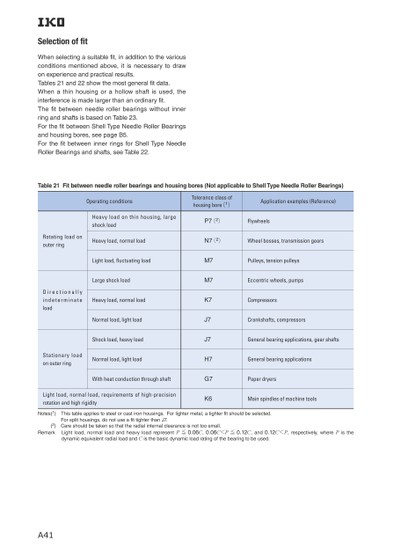
Selection of fitWhen selecting a suitable t, in addition to the various conditions mentioned above, it is necessary to draw on experience and practical results.Tables 21 and 22 show the most general t data.When a thin housing or a hollow shaft is used, the interference is made larger than an ordinary t.The fit between needle roller bearings without inner ring and shafts is based on Table 23.For the t between Shell Type Needle Roller Bearings and housing bores, see page B5.For the t between inner rings for Shell Type Needle Roller Bearings and shafts, see Table 22.Table 21 Fit between needle roller bearings and housing bores (Not applicable to Shell Type Needle Roller Bearings)Operating conditionsTolerance class of housing bore1)Application examples (Reference)Heavy load on thin housing, large shock loadP7(2)FlywheelsRotating load on outer ringHeavy load, normal loadN7(2)Wheel bosses, transmission gearsLight load, fluctuating loadLarge shock loadDirectionally indeterminate Heavy load, normal loadloadNormal load, light loadShock load, heavy loadStationary load on outer ringNormal load, light loadWith heat conduction through shaftLight load, normal load, requirements of high-precision rotation and high rigidityM7M7K7J7J7H7G7K6Pulleys, tension pulleysEccentric wheels, pumpsCompressorsCrankshafts, compressorsGeneral bearing applications, gear shaftsGeneral bearing applicationsPaper dryersMain spindles of machine toolsNotes(1)This table applies to steel or cast iron housings. For lighter metal, a tighter t should be selected.For split housings, do not use a t tighter than J7.(2)Care should be taken so that the radial internal clearance is not too small.Remark Light load, normal load and heavy load represent P≦0.06C, 0.06C<P≦0.12C, and 0.12C<P, respectively, where P is the dynamic equivalent radial load and C is the basic dynamic load rating of the bearing to be used.A41
 | <
| <  |
|  > |
> |  >>
>>