>> P.25
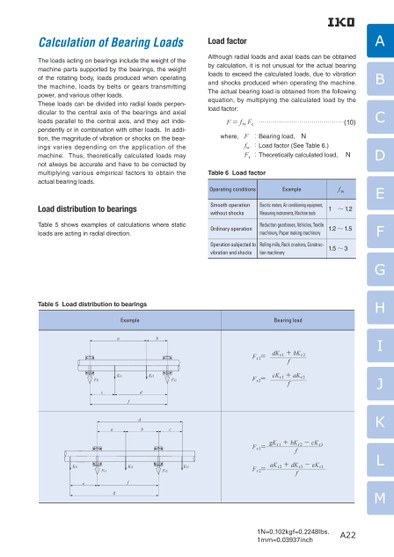
ABCDEFGHIJKLMCalculation of Bearing LoadsLoad factorThe loads acting on bearings include the weight of the machine parts supported by the bearings, the weight of the rotating body, loads produced when operating the machine, loads by belts or gears transmitting power, and various other loads.These loads can be divided into radial loads perpen-dicular to the central axis of the bearings and axial loads parallel to the central axis, and they act inde-pendently or in combination with other loads. In addi-tion, the magnitude of vibration or shocks on the bear-ings varies depending on the application of the machine. Thus, theoretically calculated loads may not always be accurate and have to be corrected by Although radial loads and axial loads can be obtained by calculation, it is not unusual for the actual bearing loads to exceed the calculated loads, due to vibration and shocks produced when operating the machine. The actual bearing load is obtained from the following equation, by multiplying the calculated load by the load factor:F= fw Fc ……………………………………(10)where,F :Bearing load,Nfw :Load factor (See Table 6.)Fc :Theoretically calculated load, Nmultiplying various empirical factors to obtain the Table 6 Load factoractual bearing loads.Load distribution to bearingsOperating conditionsExamplefwSmooth operation Electric motors, Air conditioning equipment, without shocksMeasuring instruments, Machine tools1〜1.2Table 5 shows examples of calculations where static loads are acting in radial direction. Ordinary operationReduction gearboxes, Vehicles, Textile machinery, Paper making machinery1.2〜1.5Operation subjected to Rolling mills, Rock crushers, Construc-vibration and shockstion machinery1.5〜3Table 5 Load distribution to bearingsExampleabKr1Kr2Fr2ddbfKr2fagcKr3Fr2Fr1cKr1eFr1Bearing loadFr1=Fr2=dKr1+bKr2fcKr1+aKr2fFr1=gKr1+bKr2-cKr3fFr2=aKr2+dKr3-eKr1fA22
 | <
| <  |
|  > |
> |  >>
>>